karate
what is karate?
Historical background
The term Karate commonly refers to a martial art originally known as Tode, or simply Te (手, meaning “hand” or “technique"), which represents the indigenous fighting methods of Okinawa. This art developed over centuries, influenced by various cultures due to Okinawa’s location between mainland Japan, China, and Southeast Asia. While a later interpretation of the word 'kara' is "empty", providing karate the meaning of "empty hand" (with different meanings for it), an earlier interpretation highlights the Chinese influence on these arts. The character “To”, which is also pronounced “Kara”, was the term used for the T’ang dynasty, and China in general, which means that Tode, or Karate, is interpreted as "Chinese hand". In 1922, Karate was officially introduced to the Japanese by Gichin Funakoshi, who is known as the founder of Shotokan karate. Prince Hirohito was very impressed by the Okinawan art, and as a result, Jigoro Kano, the founder of Japanese Judo, invited Funakoshi to remain in Japan to teach karate, establishing the "Japanization" of karate.
In Okinawa, different approaches were developed in several provinces, including Shuri, Naha, and Tomari, known as Shuri-te, Naha-te, and Tomari-te, respectively. Each style highlights different skills and training methodologies. While these styles represent geographical distinction, around the 1920s, karate began to be taught in a systematised way and organised into distinct schools.
Karate schools
Nowadays, there are many recognizable karate schools and styles, although generally, the main styles of Japanese karate are:
-
Goju-ryu - developed out of Naha-te, by Chojun Miyagi (1888–1953). Miyagi traveled to Fujian Province, China, to research martial arts, which deeply impacted his concept of martial arts. In 1930, when required to register his style with the Dai Nippon Butokukai, he named his style Goju-ryu (“hard-soft style”), drawing inspiration from the famous Bubishi (“Howa Goju o donto su” – inhaling represents softness/exhaling represents hardness). In Goju-ryu, much emphasis is placed on combining soft circular blocking techniques with fast counterattacks, powerful breathing exercises, and close-quarters combat principles.
-
Shotokan - founded by Gichin Funakoshi (1868-1957) and rooted in Shuri-te and Tomari-te. Funakoshi was born in Okinawa and began to study karate with Asato Anko, one of Okinawa’s greatest experts in the art. In 1939, Funakoshi opened his own training dojo he called Shotokan: “Shoto” was the name he used when doing calligraphy and writing poetry, which also means “Pine Waves,” and refers to the sound of wind blowing through the pines. Shotokan Karate is characterized by powerful linear techniques and strong stances.
-
Wado-ryu - founded by Ohtsuka Hironori (1892–1982) in Tokyo in 1934. His curriculum was a fusion of Shotokan karate with Shindo Yoshin Ryu ju jutsu, wado-ryu means ‘way of harmony’, combining basic jujitsu and emphasis on softness and spiritual discipline.
-
Kyokushin - founded and officially established by the Korean-Japanese Masutatsu Oyama ( 19923-1994) in 1964. This style blends Chinese Kempo and Shotokan/Goju-ryu principles and is considered a hard and aggressive style. Kyokushin meaning in Japanese is "The Ultimate Truth," representing a path of intense physical and spiritual self-discovery through rigorous, full-contact karate training.
-
Shito-ryu - founded by Kenwa Mabuni (1889-1952) as a fusion of both Naha-te and Shuri-te. Shito-ryu's distinguishing feature is its large number of kata combining Shuri-te, Naha-te, and Tomari-te elements (between 50-60 kata), a combination of both the long-distance fighting techniques of Shuri-te and the close-distance fighting with heavy movements and special breathing techniques of Naha-te, and an emphasis on the “spirit of the fist of the noble men” (kunshi no ken).
Karate methodologies
All karate teachings are based on three elements:
-
Kihon - means "basics" or "fundamentals," and refers to the core techniques practiced, including different blocks, stances, strikes, and kicks, that are continuously repeated. Practicing kihon is not only required for improving the technique itself, but also to develop physical and mental resilience, as well as cognitive abilities derived from the complex motor skills involved.
-
Kata - means "form" or "pattern," and refers to pre-arranged sequences of movements designed to be practiced individually. Each kata encapsulates fighting principles, historical and cultural elements, and more. Importantly, kata are not meant to simulate fights but to teach a language of combat, where movements have different applications (bunkai). Understanding this bunkai is crucial for our ability to perform the kata, and without it, the only value of a kata is aesthetics.
-
Kumite - means "sparring" or "meeting of hands," and refers to the practical application of techniques against an opponent. Kumite is a way to test our kihon and kata, but more importantly, our spirit. There are different types of kumite, some designed to fit sports competitions, while others focus on self-defense, and include different fighting dimensions, like takedowns, locks, etc.
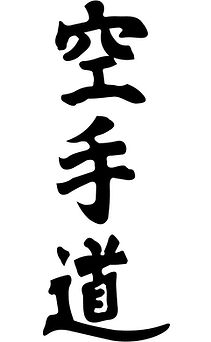
The Karate-do kanji, meaning "the Karate way".